
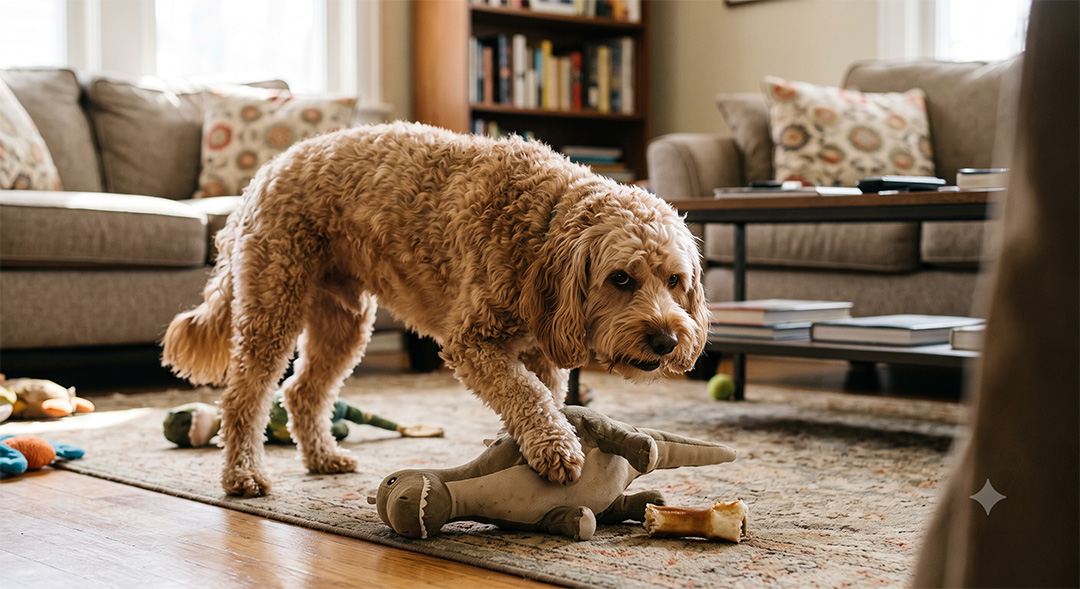
Why is my cockapoo guarding food or objects?
Cockapoos are a crossbreed between two other working breeds – the miniature poodle and, usually, the working cocker spaniel. There has been a boom in these kinds of dogs over the past number of years, along with many other doodle breeds, for their teddy bear appearance and popularity as a small to medium-sized family pet.
While there are many lovely cockapoos around, there has been a surge in breeders for these dogs, coinciding with their increasing popularity. Naturally, when there is an influx of a certain breed to the market, there is often not-so-great breeding that goes with it. This often means that looks are prioritised over breeding for behaviour and temperament.
Alongside the potential for some not great breeding, the two breeds these dogs are bred from each have their own innate genetic tendencies. The working cocker spaniel, in particular, has a genetic tendency for resource guarding. This comes from years of breeding into them a biological need to hunt and forage as part of their working lineage, where they have been used for many years to seek out and flush birds and other game, as well as to pick up, sometimes dispatch and retrieve the unalived game back to its handler.
This drive is what fundamentally leaves us with two (particularly troublesome) components of why Cockapoos tend to resource guard. They have an innate need to search things out and to pick them up. When brought inside the house, this often looks like stealing socks from the washing basket, stealing the remote, or picking up children’s toys around the house.
The other parts of the prey and foraging sequences, which they are naturally inclined to practice, lead into possessing those objects, or caching them in a safe place. In the home, this is where we often see these dogs steal an object, and then run off to their bed with it (their safe space) where they quite fiercely guard it.
The other side of the equation, the miniature poodle, is their breeding as a companion dog. Miniature poodles have been bred to be in very close proximity to us. This means they can be somewhat prone to anxiety when apart from us. This is a trait that can be made more likely when you put working breeds in a home that doesn’t provide the working fulfilment these breeds need.
What often happens, early in life, is that cockapoos quickly start to pick things up as puppies. Naturally, owners panic. Riddled with fear that these dogs will consume what they’ve picked up (which isn’t uncommon either), and be confronted with a life-threatening situation for their young puppy, and a hefty vet bill to resolve it. This means that owners fall into the trap of constantly taking things from them – often through some form of conflict, which makes it an unpleasant experience.
As the puppy grows up, they start to develop an expectation that they are going to have things taken away from them, and they start to explore routes to prevent it from being taken. It only takes one example of a young puppy growling and nipping at its owner for the owner to be startled and for the young cockapoo to have learnt a very troublesome lesson – they can use aggression to keep hold of these treasured possessions.
Is resource guarding due to fear?
While resource guarding can come from a sense of fear of losing an object, this isn’t nearly as common as people sometimes think, and very often this isn’t the case with cockapoos.
Unfortunately, the success achieved from possessing an object through some form of aggression becomes internally rewarding. Imagine you just learned you could control something 20 times your size to keep hold of all of the things you find valuable. How powerful that might make you feel.
This means that while early signs might feel very manageable to most owners, a little growl, for example, this behaviour is extremely unlikely to remain at this modest intensity. Each time success is achieved, the dog is both more likely to display it again and also more likely to increase the intensity with which it displays it.
The uncomfortable reality is that some dogs, particularly working cocker spaniels and cockaposs, actually quite enjoy the act of guarding things from you and seek out opportunities to do it.
How do I prevent resource guarding with my cockapoo puppy?
If you’ve just picked up your cockapoo puppy, and you’re looking to prevent resource guarding from occurring in the first place, congratulations! You are in the perfect position to prevent resource guarding from starting. Here’s how you’re going to do it:
- When feeding, leave them in peace. Don’t mess with them or their food while they’re eating – leave them alone
- Manage their space. Avoid having lots of toys around that they can pick up, and avoid them having access to things like dirty socks around the house. Preventing this behaviour from kicking in is the first port of call.
- Teach them a puppy retrieve. Have a search on YouTube for gun dog videos on teaching cocker spaniel puppies the first steps of a retrieve. This is your go-to tactic for giving them an alternative route of fulfilment.
- Don’t rush to take things off them. When they pick things up, instead of trying to take them off, praise them and fuss over them so they are more likely to come to you with the object. ‘Aren’t you clever bringing me that sock?’ Let them parade around with it. Then, you go and show interest in something you DO want them to pick up (a toy, a retrieve dummy, etc.) and invite them into a game of retrieving with that toy instead.
- Establish healthy rules and boundaries at home that are always consistently applied. This creates healthy, relaxed dogs who understand the order of things.
- Prevent success. In any instance where aggressive resource guarding starts to show its head, ensure that it isn’t successful at that moment.
Is it possible to fix resource guarding with a cockapoo?
How likely it is that you can improve or solve a resource guarding issue with your cockapoo depends on a number of different factors. The younger they are and the earlier you address the problem, the more likely you are to see a full resolution.
The reality, unfortunately, is that this is an innate and natural canine behaviour. You need to be conscious that this tendency, once established, is a fundamental part of who your dog is, and is likely to always be something they have some degree of likelihood to demonstrate at some point.
However, there are protocols you can put in place to improve the situation, make it safe, reduce the likelihood of occurrences, and achieve an enjoyable, happy life with your dog.
Resource guarding and children.
It is important to understand that resource guarding is fundamentally a form of aggression. Dogs who are otherwise lovely, happy dogs, can switch into aggressive behaviour in a way that seems like our cockapoos have had a complete personality transplant.
As adults, it is easier for us to respect a dog’s boundaries, read their body language and communication, and stick to the rules and ways of living we have in place. This is much harder for children, and especially young children, to both understand and stick to.
When it comes to children in the home and a dog that resource guards, strict rules need to be in place that all the children understand and follow without exception. The dog must not be approached while eating. Objects must not be left around that the dog might steal and guard. Children must not be left unattended with the dog at any time. The dog must not be overhandled by the children (such as bear hugs or forced interaction).
How do you train a resource guarding cockapoo?
When it comes to treating resource guarding in cockapoos, there are a number of avenues of training that can be explored.
The first is management. We need to create a space where they are unable to practice and repeat the behaviour of stealing things. So no toys left all over the floor, no long-lasting chews unless they are in a space where they won’t be disturbed and during feeding times, they are left on their own to eat.
The second is creating clear rules and boundaries in the home. This includes things like sitting and waiting to be fed, waiting to be released through doorways, not being allowed upstairs or other privileged positions such as sofas, beds etc.
Play is often used to treat resource guarding, provided there are safe ways to practice it, as this is a great way to practice swapping and giving up items in a way that takes the conflict out of it and makes it a happy experience.
Other training activities, particularly for these kinds of dogs, include teaching retrieves and other gundog-style training. Breed-specific enrichment in this way is often a fundamental part of the plan.
There are also ‘food-throwing’ protocols, which can be deployed in some circumstances where dogs are guarding food rather than objects.
In some cases, direct consequences are the most effective practice to employ. Such as losing access to the guarded resource, or having the behaviour abruptly interrupted by an unpleasant stimulus. This can take several different forms depending on the trainer and the circumstances, and is an ethical balance between the risk of not treating the behaviour (danger to the family, rehoming of the dog, or, in an unfortunately significant number of cases, euthanasia) versus a short-lived, unpleasant but not physically harmful experience for the dog.
The plan put in place very much depends on the severity of the case, what is being guarded and the risk the dog currently presents in the home, among other things, when assessing the right route forward for any given situation.
Will my cockapoo grow out of resource guarding?
Unfortunately, it is extremely unlikely that a cockapoo, once they have started resource guarding and found it to be successful, will simply grow out of it with no other intervention. The most likely scenario with no action taken is that the behaviour develops and increases as they progress from adolescence to adulthood. This makes it incredibly important to seek support with a resource guarding cockapoo as soon as you have identified that it is an issue.
Advice to avoid when it comes to resource guarding
Resource guarding is one of those behaviours where there is a lot of really quite terrible, outdated, and often dangerous advice. There are some of the key areas that are definitely not good advice.
- Putting your hand in their food. This is very outdated advice and is more likely to create an issue that prevents it.
- Spitting in their food. I don’t know who came up with this rubbish – but no, this doesn’t work.
- Practising stroking or touching your dog while they eat. Again, don’t do it. Leave your dog to eat in peace. Again, this is likely to cause an issue rather than solve it.
One are to be careful with, rather than avoiding entirely, is any protocols that include throwing food while your dog is eating or has an object. It’s valid that these protocols can work to condition your approach as a positive thing, rather than a negative thing – but you have to be very careful that you aren’t inadvertently adding extra rewards when your dog is guarding, and then moving away from them, suggesting to them that the guarding has worked. You need to be working with a trainer or behaviourist who can prescribe and support the right approach for your given situation.